
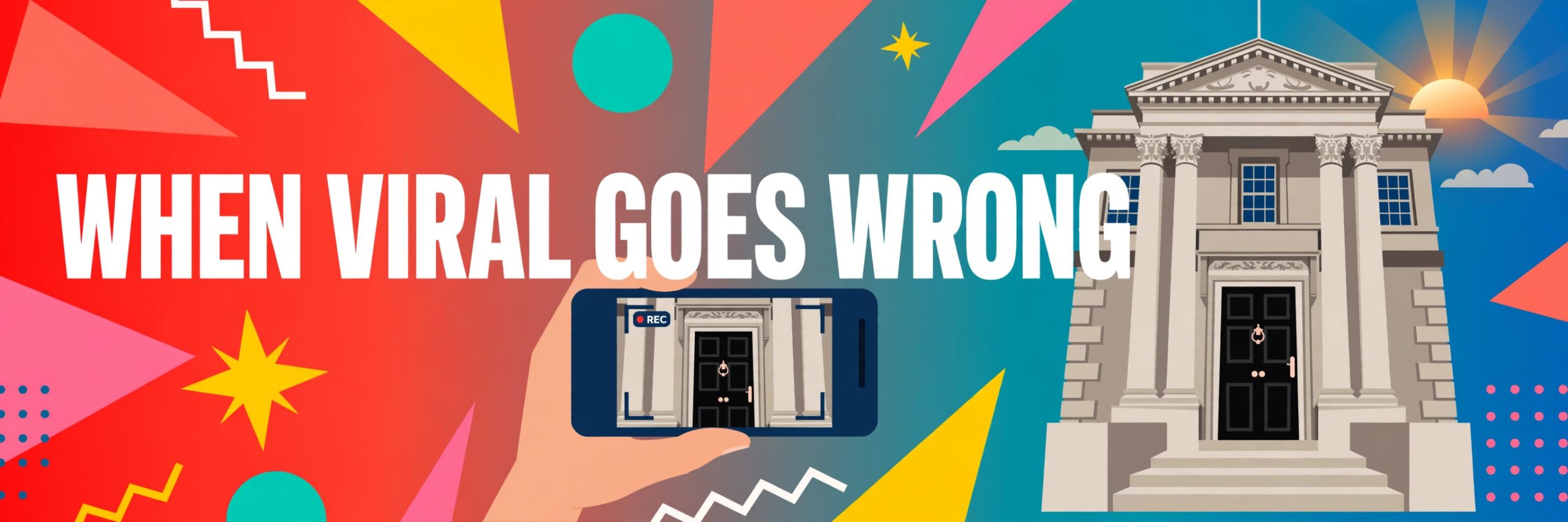
A TikTok creator walked up to one of the most famous doors in the world, filmed a short clip, and posted it like any other video. Within hours, the clip was everywhere — and not in the way he wanted. The video was deleted, the prime minister’s team had its say, and the whole episode became a case study in what happens when a viral moment crosses a line.
The clip lasted only seconds. The lessons from it will last a lot longer. Here is what happened, why it turned, and what creators can take from it. If a video of yours ever starts moving faster than expected, a quick check with the TikTok Video Analytics tool can show how it is performing while you still have time to decide what to do next.
What Happened at Downing Street
| Detail | What happened |
|---|---|
| Creator | Max Balegde, a UK TikTok creator |
| Location | Outside Number 10 Downing Street, London |
| Occasion | A content creators’ reception at Downing Street |
| The video | A short clip outside the famous black door, mouthing along to a viral meme audio and performing a salute |
| Reaction | The clip went viral fast and drew heavy criticism online |
| Outcome | The video was deleted, and Downing Street’s team publicly backed the decision |
Max Balegde was one of a number of creators invited to Downing Street for a reception for content creators. On the same day, he also hosted a separate event on domestic abuse — serious work that sat in strange contrast to the light-hearted clip. The video showed him standing outside the black door of Number 10, mouthing along to a popular meme audio with explicit lyrics, before performing a salute to camera.
It looked like the kind of quick, jokey clip creators post every day. But the setting changed everything. Number 10 is not a random street corner — it is the home and office of the prime minister, wrapped in history and formality. A joke that lands fine in a bedroom or a park can read very differently on those steps.
Why the Clip Spread — and Why It Turned
The video had all the ingredients of a viral hit: a famous location, a recognisable meme audio, a creator with a big audience, and the novelty of a TikTok star at the centre of British political power. It spread quickly, and at first the attention probably felt like a win.
Then the tone shifted. Critics argued the clip was inappropriate and tasteless given the setting, and that the language in the audio had no place at the prime minister’s front door. Others pushed back, saying the fuss was overblown and a short joke outside a building harmed nobody. The argument itself became part of the story, and every new post about it pushed the clip further.
This is a pattern creators know well: a video goes viral because it gives people something to argue about. The location made it newsworthy, the audio made it shareable, and the disagreement made it unstoppable. Soon the clip was a national talking point, discussed on television and raised with a government minister.
The controversy was put to Satvir Kaur, the Minister for Violence Against Women and Girls, in a television interview. She said she was personally not comfortable with the language used in the video, while adding that she did not want to stop the prime minister from having important conversations with a wide range of people. That answer kept the story alive for another news cycle.
The Response From Downing Street
Then came the official word. A spokesperson for Prime Minister Andy Burnham said the prime minister’s view was that the content was clearly not acceptable, that it was right for the creator to take the video down, and that content creators are responsible for what they post.
Each point matters. The first set the tone: this was not a grey area. The second gave the creator a way out: deleting the video was the right call. The third was the real message for every creator watching: responsibility follows the post, wherever it is filmed and whoever invited you in.
The video has since been deleted. As of the latest reporting, Max Balegde has not publicly commented on the controversy. The silence is understandable — when a clip becomes a news story, anything a creator says next becomes part of the same story.
The episode came in the same week as another Downing Street creator moment, when TikTok creator Luke Hamnett filmed himself dancing through the building during a podcast visit with the prime minister. That clip was received as a playful, warm moment. Two creators, the same building, the same week, two very different outcomes — the difference was the content, the tone, and the judgment call behind each video.
7 Lessons Every Creator Should Learn
1. The location is part of the content
A video is never just what you do in it. Where you film it changes how people read it. A joke at home is a joke; the same joke outside a government building, a place of worship, or a memorial becomes a statement, whether you meant it as one or not. Before filming somewhere famous or formal, ask how the clip would look to someone who has never seen your content.
2. Meme audio is not neutral
Trending sounds carry meaning before you even appear on screen. The audio here was a viral meme with explicit lyrics, and those lyrics became the centre of the criticism. Listen to the full audio and imagine the words quoted back to you in a news report. If that thought makes you uncomfortable, pick another sound.
3. Being invited in is not a free pass
Max Balegde was invited to Downing Street. He was a guest, not a tourist sneaking a photo. But an invitation to a place is not an invitation to do anything there. The more official the invitation, the more carefully people will judge what you do with it. Access is a privilege, and audiences notice quickly when it looks like it is being treated casually.
4. Virality and approval are not the same thing
The clip went viral and drew heavy criticism at the same time. Creators often treat views as approval, but a video can explode precisely because people dislike it or find it shocking. Before you celebrate a spike, look at what people are actually saying — a video that grows from outrage is a very different asset from one that grows because people love it.
5. Deleting is a decision, not a defeat
When the backlash grew, the video came down — and even Downing Street said publicly that this was the right move. Many creators resist deleting because it feels like losing, or because the views are still climbing. But a video that is hurting your reputation is not an asset, no matter how many views it has. Deleting quickly and quietly stops the spread and lets the conversation move on.
6. Silence can be smarter than a statement
After the video was deleted, Max Balegde did not rush out a public comment. That restraint is worth noting. When a clip becomes a news story, a hasty apology video can become the next news story, and a defensive response can restart the whole argument. Sometimes the best response is to take the video down, let the moment pass, and speak only when you have something clear and honest to say.
7. Your audience is bigger than your followers
A creator’s real audience is not just their followers. It is everyone who sees the clip after it is shared, screenshotted, or reported in the news. The Downing Street video was judged by politicians, journalists, and people who had never opened TikTok. The safest test is simple: would this video still be fine if it appeared on the evening news?
What to Check Before Filming at a Famous Location
Famous locations are tempting — they make a video instantly recognisable and shareable. But they also raise the stakes. Run through this checklist before you press record.
- Know the rules of the place. Some locations ban filming, some require permission, and some allow it only in certain areas. Check before you go, not after you post.
- Match the tone to the setting. A formal, historic, or sensitive location calls for a different energy than a street, a park, or your own room.
- Read the audio out loud. If you would not say the words in that place yourself, do not mime them there either.
- Keep other people out of frame. Staff, security, other guests, and passers-by did not agree to appear in your video.
- Ask what the headline would be. If a news site wrote about your clip tomorrow, what would the headline say? If the answer makes you wince, rethink the video.
- Remember the invitation. If you were invited somewhere, you represent the person who invited you. Act like a guest, not an owner.
What to Do When a Video Starts Going Wrong
Every creator will eventually post something that lands badly. What happens in the first few hours usually decides whether it becomes a bad day or a lasting problem. First, stop promoting the video and read the criticism properly — separate people who are upset about something real from people who are simply enjoying the argument.
Next, decide quickly whether the video should stay up. If the problem is a misunderstanding, a pinned comment might fix it. If the problem is the content itself — the words, the setting, the tone — taking it down is usually the cleaner choice. A quick check of how the video is actually performing, through a tool like the TikTok Video Analytics checker, can help you separate a real backlash from a small group of loud replies. Finally, do not feed the cycle: arguing in the comments or posting a heated response video almost always makes things worse.
Why This Story Matters for Pakistani Creators Too
The setting was London, but the lesson travels. Pakistani creators film at famous places all the time — historic sites, government buildings, busy markets, family events, and religious occasions — and a clip filmed at a respected location carries the weight of that location. The same goes for trending audio borrowed from abroad and for invitations to brand events and launches: check what the audio actually says, and treat access as trust to protect, not something to spend.
Frequently Asked Questions
Who is Max Balegde?
Max Balegde is a UK TikTok creator and influencer. He was invited to Downing Street for a content creators’ reception, where he filmed the short video at the centre of this controversy.
What was in the Max Balegde Downing Street video?
The clip showed him outside the black door of Number 10, mouthing along to a viral meme audio with explicit lyrics and performing a salute. It was later deleted after drawing heavy criticism online.
Why was the video criticised?
Critics argued the language in the audio and the jokey tone were inappropriate for the setting — the home and office of the prime minister. Others felt the reaction was overblown, and the disagreement itself helped the clip spread.
What did Downing Street say about the video?
A spokesperson for the prime minister said the content was clearly not acceptable, that it was right for the creator to take the video down, and that content creators are responsible for what they post.
Has Max Balegde commented on the controversy?
As of the latest reporting, he has not publicly commented. The video has been deleted.
Should creators delete a video when it gets backlash?
Not always. If the backlash comes from a misunderstanding, an explanation can fix it. But if the content itself is the problem, deleting quickly is usually the strongest move.
The Bottom Line
The Max Balegde story is not really about one video. It is about the gap between how a creator sees a clip and how the rest of the world sees it. To the person filming, it was a quick joke at a famous door. To everyone else, it was a statement made at the centre of power, set to lyrics that did not belong there.
Creators do not need to stop filming at interesting places or using trending sounds. They need to slow down before they post and ask: does this fit the setting, would I be comfortable if this appeared on the news, and am I ready to stand behind it if it spreads further than my followers? If the answer to any of those is no, the video is not worth the risk.
Going viral is easy. Going viral for the right reasons takes judgment. The creators who build lasting careers treat every post as if the whole world might see it — because sooner or later, it might.
On4t is not affiliated with or endorsed by TikTok.