
A creator in Lahore films a joke in Urdu. A viewer in Karachi watches it on a crowded bus. A cousin in London watches it at midnight. A friend in Dubai watches it while dinner is on the table. The video is the same — but the reason each of them stays is often the words on the screen.
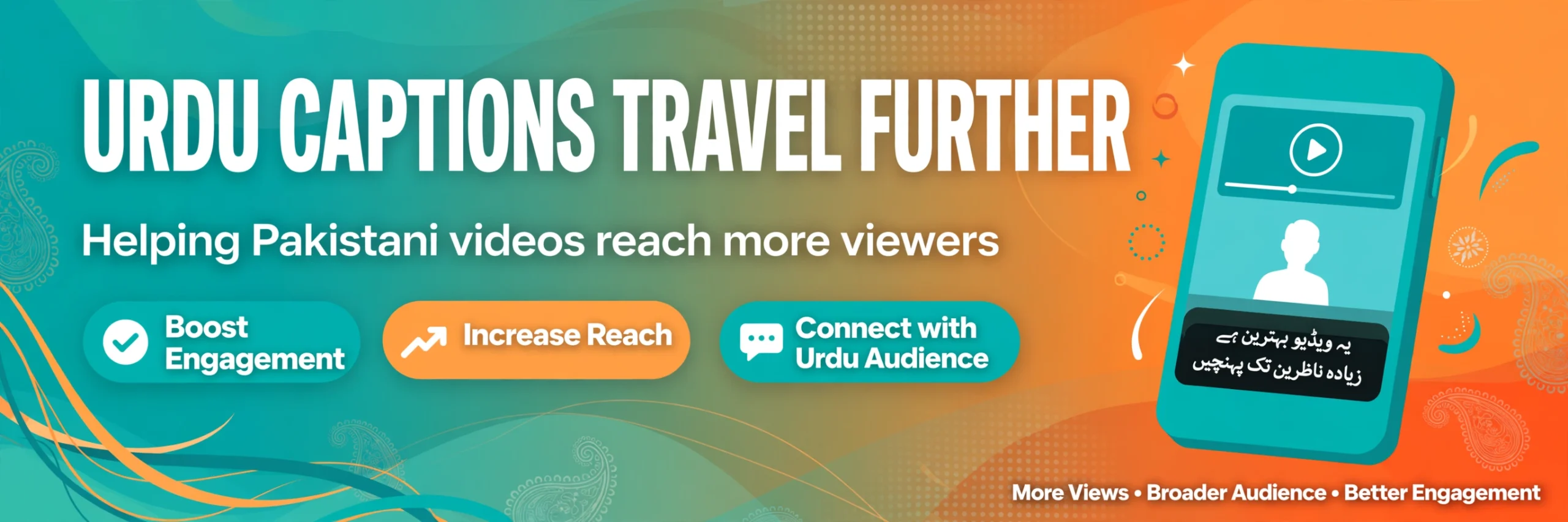
Urdu captions have quietly become one of the most powerful growth tools for Pakistani creators. They decide who can follow the video, who understands the punchline, and who shares it with someone else. A video without captions asks the viewer to turn the sound on and find a quiet corner. A video with clear Urdu captions meets the viewer wherever they are — and that is why it travels further.
Before a video goes out, its title and opening line deserve the same care as its captions. A strong title tells a scroller exactly why to stop, and On4t’s TikTok Title Generator can help a creator brainstorm title ideas in seconds. The caption then does the rest of the work inside the video.
At a Glance: What Urdu Captions Do for a Video
| What captions add | Why it matters |
|---|---|
| Words on a muted screen | Viewers follow the story without sound |
| Roman Urdu option | Matches how most Pakistanis actually type and read on phones |
| Clear Nastaliq script | Feels natural to readers who prefer Urdu script |
| Diaspora-friendly text | Urdu speakers abroad can follow every line |
| Searchable words | Titles and on-screen text help people find the video later |
| A stronger hook | The first line lands even before the sound starts |
1. Most People Watch on Mute First
People scroll in buses, classrooms and living rooms where someone else is watching television. A video that only works with sound gets skipped in all of those places.
Urdu captions change that completely. The joke lands in text. The story makes sense without audio. The viewer who would have swiped past in two seconds now watches to the end — and the longer someone watches, the further the platform carries the video. Captions are a retention tool, and retention is what decides reach.
2. Roman Urdu Is How Pakistan Actually Types
Ask a young viewer in Karachi or Lahore how they text their friends, and the answer is almost always the same: Roman Urdu. Urdu written in Latin letters — shukriya instead of شکریہ, zyada instead of زیادہ — is the everyday writing system of Pakistan’s phone generation. Keyboards made Latin letters the default, and a whole generation now reads Roman Urdu without slowing down.
This matters enormously for captions. A creator who captions only in Urdu script reaches the audience that reads Nastaliq comfortably. A creator who captions in Roman Urdu reaches the much larger group that types in Latin letters all day. Many creators now post both versions or pick Roman Urdu as the default, because it matches how their audience already reads. The caption style should mirror the audience, not the creator’s preference.
3. Nastaliq or Roman: Pick the Script Your Audience Reads
Urdu script is beautiful, but it is demanding on a small phone screen. Nastaliq letters join and flow in ways that can look cramped at caption size, especially in fast-moving video. Many caption tools were built for left-to-right Latin text and handle Urdu script poorly, sometimes breaking words or rendering them in the wrong style.
That is why burned-in captions — text baked into the video itself — have become popular for Urdu content. When the creator controls the font, the size and the placement, the words stay readable on every device. Platform auto-captions, by contrast, do not always support Urdu well, and a mistranscribed line can change the meaning of a joke entirely. The practical rule is simple: use a clean, readable Urdu font, keep each caption block short, and test the video on a real phone before posting.
4. Captions Open the Door to the Diaspora
Large Urdu-speaking communities live in the United Kingdom, the United States, Canada, the Gulf and Australia, and many of them follow Pakistani creators closely. Some speak Urdu fluently but read the script slowly. Others grew up hearing Urdu at home and understand it best when they can read along.
For these viewers, captions are the bridge. A video with clear Urdu or Roman Urdu captions lets a second-generation viewer in London follow a Lahore vlogger’s story word for word. Without captions, that same viewer might catch the tone but miss the details — and details are what make people comment, share and follow.
5. Text Helps People Find the Video Later
Urdu captions give the platform more words to match. A video whose captions include the exact phrases people search for has a better chance of appearing in those results than a video with no text at all. The same applies to hashtags: Urdu hashtags help a video reach the audiences that actually use them, and Roman Urdu hashtags catch the viewers who type in Latin letters.
6. Captions Make the Hook Land in the First Seconds
Smart creators put their hook on screen as text in the very first frame: the surprising claim, the funny question, the promise of what is coming. The viewer reads it before the audio even starts, and that reading is what buys the next few seconds of attention. Urdu captions make this even stronger, because the hook arrives in the viewer’s own language. A punchline in Urdu, written in the script the viewer reads fastest, feels personal in a way an English overlay never does.
7. A Simple Caption Workflow Any Creator Can Follow
Adding Urdu captions does not need expensive software or hours of extra work. A simple routine works for most creators:
First, write the script or the key lines before filming, so the captions are planned rather than improvised. Second, choose the script — Roman Urdu or Nastaliq — based on who watches the channel. Third, caption in short blocks that match the speech, a few words at a time, so the text never crowds the screen. Fourth, keep English words in English when the speaker uses them; mixed Urdu-English sentences are normal. Finally, watch the finished video once on mute. If the story still makes sense, the captions are doing their job.
What the Best Captioned Videos Have in Common
Look at the Pakistani videos that travel furthest, and a pattern appears. They are easy to watch anywhere, because the words are on the screen. They speak the audience’s language in the audience’s script. They are findable, because their titles and text match what people search for. And they respect the viewer’s time, because every line earns its place. None of this requires a big budget or a studio — just a creator who thinks about the person on the other side of the screen.
FAQs
Should I caption in Urdu script or Roman Urdu?
It depends on your audience. Roman Urdu matches how most young Pakistanis type and read on phones, so it is the safer default for comedy, lifestyle and vlog content. Urdu script in Nastaliq suits poetry, literature and audiences who prefer classical Urdu.
Do Urdu captions really help a video reach more people?
Yes. Captions let people watch on mute, help viewers who read along in a second language, and give platforms more text to match in search. Together, that means more people can watch, understand and share the same video.
Are platform auto-captions good enough for Urdu?
Not always. Auto-caption tools were mostly built for English and can mistranscribe Urdu, especially when the speaker mixes Urdu and English. Checking and correcting captions — or burning your own into the video — gives a much more reliable result.
How long should each caption line be?
Short. A few words at a time, matched to the speech, is the rule most creators follow. Long blocks of text are hard to read on a phone and pull attention away from the video itself.
Can captions hurt a video?
Only if they are done badly — text that covers the subject’s face, lines that are too small to read, or captions that drift out of sync with the speech. Clean, well-timed captions placed in a clear part of the frame only help.
Where do titles fit into all of this?
Titles and captions work as a pair. The title gets the click; the captions keep the viewer watching. A title written in the words people actually search for, paired with clear Urdu captions inside the video, gives a video its best chance of being found and finished.
The Bottom Line
Urdu captions are one of the simplest, cheapest advantages a Pakistani creator can add to a video. They cost nothing but a few minutes, they work on every platform, and they make a video watchable in places where sound is not an option. They welcome the diaspora, they help the platform find the right viewers, and they turn a quick scroll into a finished watch.
Start with the next video. Caption it in the script your audience reads fastest, keep the lines short, and put the hook on screen in the first frame. Then give that video a title people would actually search for — On4t’s TikTok Title Generator is a free place to brainstorm title ideas before you post. The video that can be understood anywhere is the video that travels furthest.
On4t is not affiliated with or endorsed by TikTok.