
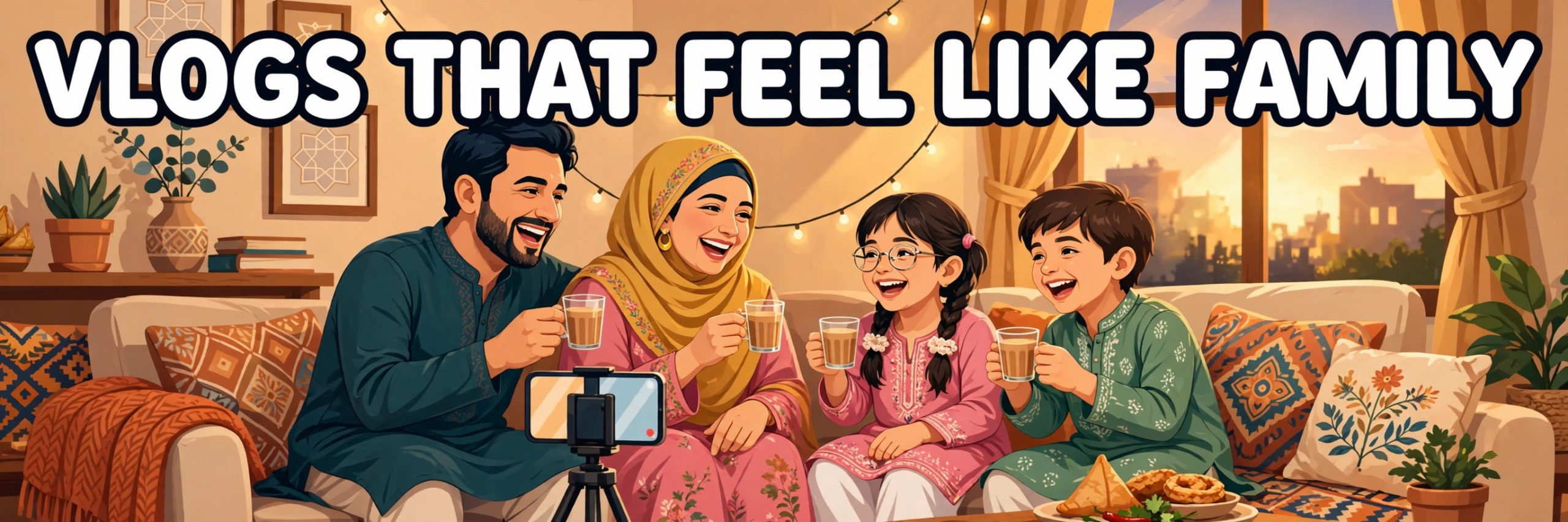
Open your phone at dinner time and you will find them: a family eating together in Lahore, a father filming his kids’ school run in Karachi, a couple sharing chai in Islamabad. You have never met these people, yet after a few videos you know their routines, their jokes, even their living room. That is the magic of the Pakistani family vlog — it does not feel like watching a show. It feels like visiting family.
So why do some vlogs create that warm, familiar feeling while others, filmed with better cameras and bigger budgets, leave viewers cold? The answer is simpler than most creators think. It is not the editing, the thumbnail, or the equipment. It is consistency — showing up, day after day, until strangers start to feel like relatives. If you want to see which of your own uploads build that bond, the TikTok Video Analytics Checker shows which videos keep viewers watching till the end and which ones they skip.
At a Glance: What Makes a Vlog Feel Like Family
| Ingredient | What Viewers Feel |
|---|---|
| Consistent uploads | “They are always here” — a habit forms |
| Real daily routines | “That is my life too” — instant relatability |
| Shared family rituals | “I am part of this household” — belonging |
| Honest, unpolished moments | “They are not pretending” — trust |
| Replies and reactions | “They notice me” — a two-way relationship |
Consistency Is the Real Secret
Think about how real family works. You do not see your relatives once and call it a relationship. You see them at every Eid, every wedding, every Sunday lunch. The bond is built by repetition — the same faces, the same place, the same warmth, again and again. Family vlogs work the same way.
When a creator uploads on a steady rhythm, viewers start to expect them. The vlog becomes part of the viewer’s own routine — chai in the evening, a video from a favourite family while dinner cooks. Research on online video keeps finding the same pattern: a steady upload schedule signals reliability, and reliability builds trust. Trust turns a casual viewer into someone who comments, shares, and comes back tomorrow.
That is why the creators who last are rarely the ones with one viral hit. They are the ones who kept showing up after the excitement faded — a father filming his daughters every single day, even when he was tired and the equipment glitched, built a community that now spans the globe. Not because any single video was perfect, but because the chain of videos never broke. Each upload was a small promise kept: I am here, I care, I will be here again tomorrow.
The Camera Becomes a Family Member
Watch the daily vlogs of Maaz Safder and you will see what consistency looks like in practice. His channel, built around life with his wife Saba Maaz and their young son, is not built on stunts or spectacle. It is built on ordinary days — family trips, meals together, small celebrations — filmed again and again until viewers feel they know the household.
Ordinary Days Beat Big Productions
Ask viewers why they love family vlogs and the answer is almost always the same word: relatable. The appeal of a family vlog is the presentation of ordinary life — the school run, the kitchen mess, the sibling argument, the parents laughing at a joke that only makes sense inside that house. As one media study of family vlogging puts it, the genre succeeds because it shares “the unexciting, everyday, in between stuff” that polished television never shows.
That ordinariness is exactly what makes viewers feel at home. A viewer watching a family eat dinner in Faisalabad sees their own dinner table. A parent watching another parent handle a tantrum feels less alone. The best family vloggers do not hide the tough moments either — the tired days, the disagreements, the worries. That vulnerability turns a simple video diary into a connection, because viewers see they are not alone in their own family’s challenges.
The Vloggers Who Turned Routine Into Ritual
Look at the creators who have made family content their identity, and a pattern appears. Zaid Ali T built his audience on desi family humour — his mother, lovingly known to fans as Mama Bear, became as familiar as any character on television, and his videos with his wife Yumna Zaid turned everyday married life into shared jokes the audience felt part of. The family was not a backdrop; it was the show.
Sham Idrees and his wife Sehar, known to fans as Froggy, built their channel the same way — entertaining vlogs and pranks filmed as a couple, with their daughters growing up on camera and viewers growing attached to each new chapter of the family story. Zulqarnain Sikandar, Sistrology, Minsa Saim Omer, Rabeeca Khan and Hira Faisal all come from the same school: the family is the content, the routine is the format, and the audience is invited in like a relative who drops by every day.
What They All Have in Common
Strip away the different cities, families and styles, and the successful family vloggers share five habits:
They show up on schedule. Whether it is daily or several times a week, the audience knows when to expect them. A missed week is felt like a missed visit.
They film real life, not a performance. The camera runs during breakfast, during chores, during the boring parts — the parts viewers recognise from their own homes.
They let the family be itself. Kids are noisy, parents tease each other, grandparents steal the scene. Nobody is acting a role, and that is why it works.
They protect the feeling, not the polish. A shaky clip of a genuine laugh beats a flawless clip of a staged moment. Viewers forgive bad lighting; they do not forgive fakeness.
They talk back. The creators who last read comments, answer questions, and let the audience shape what comes next. Viewers stop being an audience and start being part of the household.
How New Creators Can Build the Same Feeling
If you are starting a family channel — or any channel that wants viewers to feel at home — the playbook is refreshingly simple, and every step is organic. No tricks, no shortcuts, just habits that compound.
First, pick a schedule you can actually keep and keep it. Three honest videos a week, every week, will beat a month of daily uploads followed by silence. Your viewers need to know when to find you. Second, film the day you actually had, not the day you wish you had. The school run, the cooking, the evening walk — these are the scenes your audience lives too, and recognition is the fastest route to connection.
Third, make room for the people around you. A vlog that only ever shows one person feels like a performance; a vlog where the whole family drops in feels like a home. And reply to the people who show up for you — a creator who answers comments turns viewers into regulars, and regulars into a community that promotes the channel for you, simply by caring.
Finally, study what is actually working instead of guessing. Look at which of your videos hold viewers till the end and which ones lose them in the first seconds, then make more of what holds them. A quick check with the TikTok Video Analytics Checker shows you the retention and engagement pattern of any video, so your next upload can be built on evidence instead of hope.
Frequently Asked Questions
Why do family vlogs feel more personal than other videos?
Because they show ordinary, repeated life. When you watch the same family eat, travel, argue and celebrate week after week, your brain starts treating them like people you know. Repetition creates familiarity, and familiarity feels like family.
How often should a family vlogger upload?
As often as you can sustain without burning out. Daily uploads build the fastest bond, but three steady videos a week kept for a year will outperform a month of daily videos followed by silence.
Do family vlogs need expensive equipment?
No. Viewers come for the family, not the camera. A phone, natural light and honest moments are enough — many of the most loved family channels started with basic gear and grew because the content felt real.
What makes viewers leave a family channel?
Inconsistency and fakeness. Long unexplained breaks break the habit, and staged drama breaks the trust. Viewers forgive a quiet week if you tell them why; they do not forgive feeling fooled.
Can a solo creator get the same family feeling?
Yes, if the audience becomes the family. Solo creators who reply to comments, share routines and let viewers into their daily life build the same warmth.
The Bottom Line
Some Pakistani vlogs feel like family because they behave like family. They show up regularly, they share the ordinary days, they laugh at their own mess, and they let you in. Consistency is the secret because consistency is what turns watching into knowing — and knowing into caring. The creators who understood that did not need a viral moment. They needed a routine, a camera, and the patience to keep both going.
If you are building a channel of your own, start with the simplest promise you can keep: be there, on time, as yourself. Film the day you actually lived, answer the people who watched it, and check what held their attention so the next video holds it longer. The family feeling is not a filming technique. It is a habit — and habits are built one upload at a time.
On4t is not affiliated with or endorsed by TikTok.