
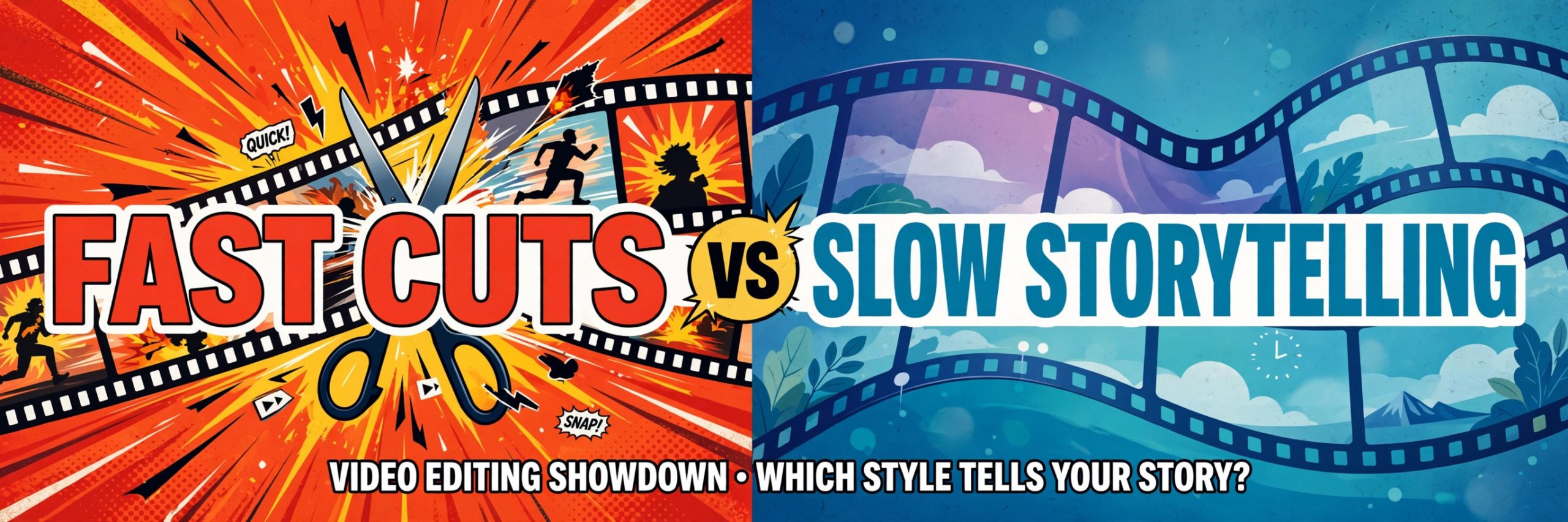
Every creator has faced this editing-room dilemma: chop the footage into rapid-fire cuts so the energy never dips, or let the story breathe with longer, deliberate shots? Fans praise both — the snappy transitions that make a minute feel like ten seconds, and the slow, cinematic build that keeps people watching to the end. Neither style is universally better; editing pace works like seasoning, and the right amount depends on the dish. Research on viewer retention does show that pacing is one of the strongest levers a creator has for holding watch time. If you want to see how your own pacing choices are landing, a tool like the TikTok Video Analytics Checker shows you exactly where viewers drop off, so you can connect editing decisions to real retention data instead of guessing.
Fast Cuts vs Slow Storytelling: The Quick Look
| Style | Best for | How it holds attention | Main risk |
|---|---|---|---|
| Fast cuts | Dance, transitions, comedy bits, showcases | Constant novelty keeps the brain’s alertness system engaged | Viewer fatigue — nothing feels special when nothing slows down |
| Slow storytelling | Vlogs, documentaries, emotional stories, explainers | Deeper emotional connection and better memory of what was watched | Early drop-off if the opening does not promise a payoff |
| Hybrid rhythm | Most creator content in 2026 | Energy spikes followed by breathing room | Harder to edit; needs deliberate planning |
What Fast Cuts Actually Do to a Viewer’s Brain
Fast cutting changes how the brain processes what it is watching. Neuroscience research has found that rapid scene changes, especially cuts shorter than a couple of seconds, activate the visual cortex and the amygdala, the brain’s alertness center — quick cuts keep the viewer in a state of heightened attention, because each new shot is a small novelty hit for the brain’s reward system.
That is why fast-paced editing feels so natural on short-form platforms. A widely cited 2024 study of TikTok viewing habits found that viewers start drifting within the first few seconds when the pacing feels sluggish. On a feed where the next video is one swipe away, an opening that takes its time gets skipped — which is why dance, transition, and comedy creators cut every second or two.
There is also a time-perception effect. Research on editing density found that viewers feel time “flies” more while watching fast-paced videos — yet they also tend to overestimate how long the video actually was. That combination is powerful: the video feels quick and fun while watching, but leaves a strong impression afterward.
But fast cuts have a ceiling. When every shot is short, the brain adapts, the novelty stops registering, and the video becomes background noise. Creators who cut fast for an entire upload often see their retention dip in the middle — the audience is not surprised anymore, just tired. Speed without variation is a different kind of monotony.
Why Slow Storytelling Still Wins for Certain Videos
If fast cuts are about alertness, slow storytelling is about connection. Brain imaging studies suggest that longer shots — several seconds or more — engage the brain’s default mode network, the system associated with reflection, empathy, and deeper processing. This is the mode viewers enter when they are genuinely following a story rather than just reacting to stimuli.
That is why the slow style dominates vlogs, documentaries, emotional storytelling, and educational content — a creator telling a personal story needs the viewer to settle in, not brace for the next cut. Slower pacing also improves memory: studies link longer shot durations to better recall of the content afterward. For creators whose goal is to be remembered — not just watched — that matters enormously.
The risk is the opening. Slow storytelling only works once the viewer has decided the payoff is worth the wait. The creators who succeed with slow pacing almost always earn it with a strong hook first — a promise, a question, or a striking moment — before they allow themselves to slow down.
The Hybrid Styles Top Creators Actually Use
The most successful creators in 2026 do not pick a side — they blend both styles within a single video, and recent analysis of high-retention channels has mapped how.
One well-documented pattern is progressive rhythm: start tight with quick visual changes to hook the viewer, then gradually widen the pacing once the audience is invested. The energy that opens the video is not the energy that closes it — and that is deliberate.
Another is the contrast pattern: calm, slow talking-head pacing for most of the video, broken every few minutes by a short burst of rapid cuts before returning to calm. The bursts act like punctuation marks — they re-engage attention precisely when it would otherwise drift.
The narrative loop returns to the original hook every few minutes so the viewer never loses the thread, the hybrid tempo alternates fast micro-cuts during explanations with slow holds on examples, and the anchor pattern drops fixed timing entirely — cuts are triggered by emotional beats like a reveal or a punchline.
What all these patterns share is intentionality: pace the video like a composer paces music — fast where the energy belongs, slow where the meaning lives.
Genre by Genre: Which Style Fits Your Content
Dance and transition videos live on fast cuts — kinetic energy synced to a beat, a new visual idea every second or two. Comedy sketches benefit from deliberate timing: hold the setup long enough for the awkwardness to land, then cut fast for the punchline. Food content is a natural hybrid — quick cuts for the prep montage, but the money shots (the cheese pull, the steam rising) need to breathe.
Educational content leans slow — explanatory videos benefit from longer shots that give viewers time to process information. Vlogs and lifestyle content reward the anchor pattern: everyday pacing most of the time, faster montages for travel sequences, slower holds for emotional moments.
How to Test Which Style Your Audience Prefers
Research describes tendencies, not rules. Upload two versions of similar content — one tighter, one slower — and compare retention graphs side by side. The TikTok Video Analytics Checker gives you a full stat breakdown and a performance score per video, so you can compare pacing choices with data instead of gut feeling.
Watch first-seconds retention and the mid-video dip: if viewers vanish in the opening, your hook needs tightening regardless of style. If they drift in the middle, the issue is usually pacing monotony — and a contrast burst or a slower anchor moment can fix it. Test across formats too: the audience that loves your fast-cut dance clips may prefer your slower vlogs, and that is perfectly fine.
What Both Styles Have in Common
Strip away the speed debate and the principles that hold watch time are identical for both styles. The opening seconds decide everything — no pacing survives a weak hook. Variation beats consistency: the brain habituates to any unchanging rhythm. Every cut should earn its place by advancing the story or landing an emotional beat. And sound design matters as much as visuals — cuts synced to a beat or a pause in dialogue hold attention better than cuts placed at random. None of these principles mention speed: fast cuts and slow storytelling are just two ways of applying the same rules.
Frequently Asked Questions
Is fast editing always better for TikTok?
No. Fast editing suits high-energy content like dance and transitions, but tutorial, vlog, and storytelling audiences often retain better with slower, more deliberate pacing. Match the rhythm to the content, not the platform stereotype.
Why do my fast-cut videos lose viewers in the middle?
Most likely pacing monotony: the brain habituates to constant speed. Try the contrast pattern — slow down for a section, then return with a burst of energy.
Can slow videos go viral on TikTok?
Absolutely — whenever the hook earns the patience. A compelling question or an emotional premise in the first seconds lets slow storytelling hold massive watch times.
Should I use the same editing style for every video?
No. Different content deserves different rhythms, and the audience that loves your fast-cut dance clips may prefer your slower vlogs. Consistency of quality and voice matters more than consistency of cut speed.
How do I know if my pacing is working?
Check your retention analytics: strong first-seconds retention plus a flat curve through the middle means your pacing is working. Sharp drops show exactly where the rhythm failed — tighten the hook for early drops, add variation for mid-video dips.
The Bottom Line
Fast cuts and slow storytelling are not rivals — they are tools in the same kit. Fast cutting wins attention through novelty and energy; slow storytelling wins it through emotion and depth. The creators holding the best watch times in 2026 use both: quick cuts to hook and energize, slower holds to deepen and land the point. Test deliberately, and let the numbers make the call. Paste your next upload into the TikTok Video Analytics Checker and see which editing rhythm your audience rewards — then edit your next video to match.
On4t is not affiliated with or endorsed by TikTok.